Partial Knee Replacement (UKR) in Reading — Unicompartmental Knee Surgery
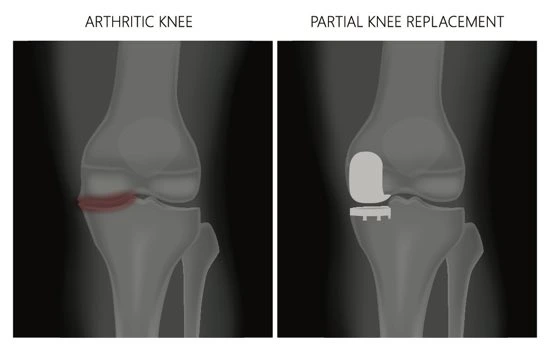
A partial knee replacement, also known as a unicompartmental knee replacement (UKR), is a targeted procedure for patients with arthritis affecting only one side of the knee — usually the inner (medial) compartment. It offers pain relief, faster recovery, and a more natural-feeling knee compared with total knee replacement.
Mr Sam Nahas, consultant knee surgeon at Circle Reading Hospital, performs partial knee replacements using modern, evidence-based techniques to achieve excellent function and longevity.
What is a partial knee replacement?
In a partial knee replacement, only the damaged compartment of the knee is resurfaced with a metal and polyethylene implant, while the healthy cartilage, ligaments, and bone are preserved.
This allows the knee to retain more of its normal motion and feel compared to total knee replacement.
Partial replacement is typically suitable for patients who have:
Arthritis limited to one side of the knee (medial, lateral)
Good range of motion
Pain and stiffness that have not improved with non operative measures
Bone on bone arthritis
Pre-operative assessment
Accurate diagnosis and selection are essential for success.
Patients undergo standing X-rays to assess the joint and in some cases high-resolution MRI to confirm that only one compartment is affected.
Mr Nahas personally reviews all imaging and assesses every patient clinically to determine whether a partial replacement is suitable or if total knee replacement would be more appropriate.
The surgery
Partial knee replacement is performed under spinal or general anaesthetic through a small incision at the front of the knee.
The damaged bone and cartilage are removed precisely, and the new implant is fitted to resurface the joint.
Mr Nahas uses modern alignment technologies to achieve accuracy in positioning.
This ensures optimal knee balance, smooth movement, and long-term durability.
Most patients are walking the same day, with many returning home within 24 hours of surgery.
Recovery and rehabilitation
Recovery after partial knee replacement is typically faster than after total knee replacement:
Hospital stay: 1 night
Walking: same or next day
Return to office work: 2–4 weeks
Return to driving: around 6 weeks, once you can perform an emergency stop safely and are off strong painkillers; this also depends on which leg was operated on and whether you drive a manual (see Driving after knee surgery)
Return to sport (golf, cycling, swimming): 8–12 weeks for gentle activity, with clearance from Mr Nahas or your physiotherapist
All patients follow a structured physiotherapy programme focusing on range of motion, strength, and walking confidence.
Evidence and outcomes
What it is: Replaces only the worn side of your knee, keeping the healthy parts and ligaments.
Recovery: Typically a smaller operation than a total knee replacement, so many people recover quicker and the knee can feel more natural.
Durability: In experienced centres, more than 9 in 10 partial knees are still going strong at 10 years.
Risks: When you look across all hospitals and surgeons, partial knees are more likely to need another operation than total knees (sometimes because other natural parts of the knee continue to wear out and get arthritis).
Who it suits: Best for people with arthritis limited to one side of the knee, good ligaments, and favourable alignment—and results are best with high-volume surgeons who do these regularly, just like Mr Nahas.
Why choose Mr Sam Nahas
Consultant knee-only surgeon specialising in joint preservation and replacement
Experienced in partial knee replacement and complex revision cases
Evidence-based practice informed by registry data and research
Head of Orthopaedics teaching at Brunel University
Trusted by physiotherapists, GPs, and patients across Berkshire
Self-pay and appointments
Self-pay packages available. No GP referral is required.
Location
All procedures are performed at Circle Reading Hospital, serving patients from Reading, Berkshire, Wokingham, Henley, Oxford, and surrounding areas.